Ladies and Gentlemen,
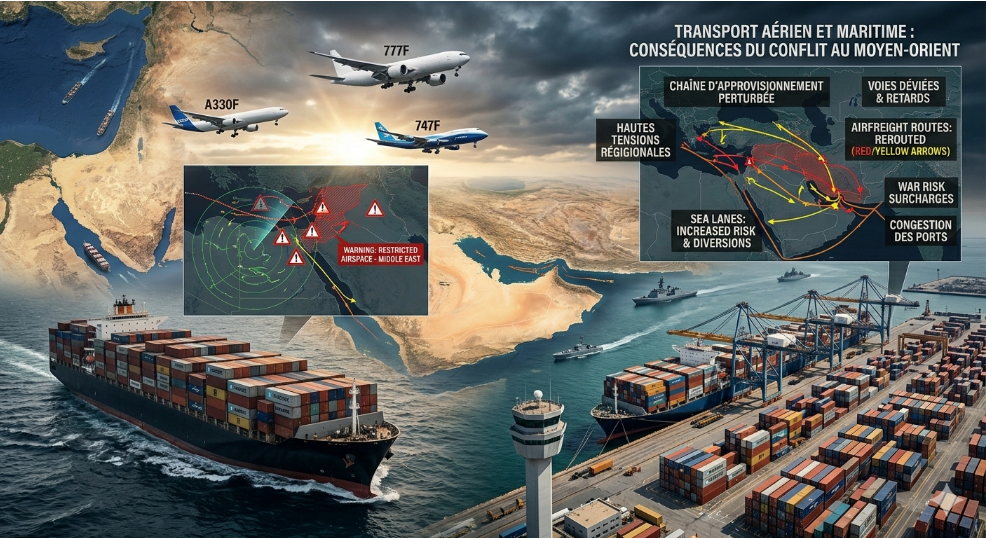
The security situation in the Middle East has deteriorated further over the past few days. Developments are having an increasing impact on major maritime and air transport corridors. International connections are currently disrupted in several areas and, in various regions, neither stable planning nor the swift processing of shipments can be guaranteed. Below is an overview of the current situation and the expected impact on sea and air freight.
1. Sea Freight: Closures, Diversions and Capacity Restrictions
Blocked shipping lanes and operational restrictions
The Strait of Hormuz is currently only partially accessible, or not accessible at all. Several vessels are anchored in safe waters, and transits through straits and critical regions have been suspended or diverted for security reasons. This affects both traffic in the Persian Gulf and connections between India, the Middle East, East Africa and the Mediterranean.
Many container ships and tankers are on standby, some with no possibility of continuing their route. This is causing delays, congestion at alternative ports and significant disruptions to regular global services.
Rerouting via the Cape of Good Hope
Many services that previously operated via the Red Sea or the Strait of Hormuz are currently being rerouted around the Cape of Good Hope. These longer routes are absorbing significant sea transport capacity, extending transit times by several days or even weeks, and reducing globally available tonnage. This is already having a notable impact on schedule reliability and equipment availability.
Surcharges and increased costs
Due to heightened risks, various types of surcharges have been introduced with immediate effect, including:
- Security or conflict surcharges for shipments to or from affected regions
- War risk surcharges, which vary considerably depending on the trade lane
- Bunker and fuel surcharges, with a greater impact due to rising energy prices
In addition, short-term adjustments to sea freight rates have been announced or already implemented. Depending on the port of origin, the trade lane and the contract date, shipments already in transit may also be affected.
Expected consequences
- Longer transit times and planning uncertainties
- Temporary suspension of acceptance for certain cargo types
- Bottlenecks at key ports outside the region due to diversions and transhipments
- Increased likelihood of capacity constraints and container shortages
2. Air Freight: Restricted Airspace and Reduced Capacity
Closed or partially restricted airspace
In several Middle Eastern countries, airspace has been closed or only partially reopened. Many international airports in the region have significantly reduced or temporarily suspended operations. This particularly affects major hubs whose closure has significant repercussions on global traffic.
Suspended air routes and longer itineraries
Many international cargo and passenger flights to the Gulf region and neighbouring countries have been suspended or diverted until further notice. The use of alternative routes results in:
- Longer flight times
- Increased fuel consumption
- Reduced payload capacity
- Operational instability in network planning
This has a direct impact on global air freight, particularly on connections between Europe, Asia and the Middle East.
Capacity decline and rising costs
Available capacity on major east-west routes has dropped by more than half in some areas. At the same time, many airlines are considering applying additional surcharges, including:
- War risk surcharges
- Fuel surcharges
- Airport storage and handling fees in the event of congestion
These factors may lead to a further short-term increase in air freight rates.
3. Impact on Supply Chains and Recommendations
Cascading effects on a global scale
Disruptions are not limited to the immediate region. Diverted capacity, stranded vessels, rerouted flights and closed hubs are having worldwide repercussions, including:
- Congestion at alternative ports and airports
- Shortages in Asian export regions
- Delays in transatlantic and transpacific traffic
- Rising energy and logistics costs
- Equipment shortages and chartering capacity constraints
Recommendations for shippers
To mitigate the impact as effectively as possible, we recommend:
- Planning ahead and booking as early as possible
- Exploring alternative routes and transport modes, including multimodal solutions
- Regularly reviewing insurance coverage, particularly with regard to war and high-risk zones
- Close coordination with logistics partners regarding available capacity, schedule changes and potential additional costs
- Maintaining flexibility on delivery timelines, especially for urgent shipments
4. Situation Assessment
The situation remains highly dynamic and may deteriorate or shift at short notice. Given the strategic importance of the region to global trade, persistent risks to shipping and air connections should be expected in the coming weeks. A return to normality is not foreseeable at this stage.
We are continuously monitoring developments and will provide our members with further updates as the situation changes or new developments arise.
We will keep you informed and remain at your disposal for any questions you may have.
Yours sincerely,
NV Logistics
Source: SpedlogSwiss — www.spedlogswiss.com